About me
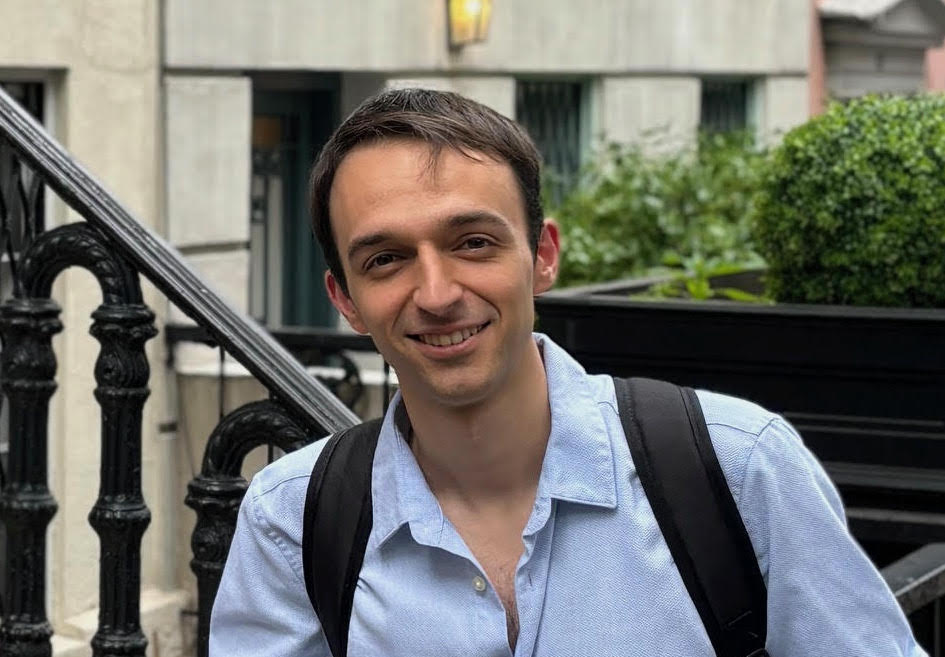
I am a Senior Researcher at Microsoft Research New England, based in Cambridge, MA. I work on generative AI models (diffusion and flow models, language models) and related topics at the intersection of machine learning, statistics, and AI for science. My works include Adjoint Matching, a reward fine-tuning framework for flow models that has been extended to chemistry and robotics, and Energy-Based Fine-Tuning (EBFT), a language model fine-tuning algorithm that relies on matching feature moments, outperforming SFT in perplexity and downstream performance while matching RLVR in downstream performance.
I received my PhD in Computer Science from NYU, where I was advised by Joan Bruna.
During my PhD, I was a Visiting Researcher at Meta FAIR Labs for two years, and prior to that, I interned at Microsoft Research and IBM Research. I obtained a B.S. in Mathematics and a B.S. in Engineering Physics from the Polytechnic University of Catalonia (UPC).
My email address is cd2754 (at) nyu (dot) edu.
Join our weekly Generative Modeling & Sampling Seminar at MSR New England, with the option to attend in person. Check upcoming talks and watch recorded talks an the seminar website. Fill out this form if you want to join the distribution list.
We are also hosting a Generative Modeling & Sampling Summer Workshop on August 10-11, 2026, at our office in Cambridge, MA. Register on the website if you want to attend!
Selected works
- JANUS: A Multi-modal Foundation Neural Sampler for Disordered Materials
Denis Blessing*, Mouyang Cheng*, Maximilian Schebek, Jutta Rogal, Mingda Li, Carles Domingo-Enrich†, Yuanqi Du†. arXiv preprint, August 2026. A multimodal neural sampler coupling continuous and discrete diffusion for thermodynamic sampling and inverse design of disordered materials. - ATLAS: A Foundation Neural Sampler for Amorphous Materials
Mouyang Cheng*, Denis Blessing*, Botao Yu, Gerhard Neumann, Mingda Li, Carles Domingo-Enrich†, Yuanqi Du†. arXiv preprint, July 2026. A diffusion-based neural sampler for sampling, steering, and designing amorphous materials directly from energy evaluations. - Reinforce Adjoint Matching: Scaling RL Post-Training of Diffusion and Flow-Matching Models
Andreas Bergmeister, Stefanie Jegelka, Nikolas Nüsken, Carles Domingo-Enrich†, Jakiw Pidstrigach†. NeurIPS 2026. Reward-based post-training for diffusion and flow models using a pretraining-style regression loss, without SDE rollouts, backward adjoint sweeps, or reward gradients. - Rare Event Analysis via Stochastic Optimal Control
Yuanqi Du, Jiajun He, Dinghuai Zhang, Eric Vanden-Eijnden, Carles Domingo-Enrich. arXiv preprint, April 2026. A stochastic optimal-control framework for learning committor functions and sampling reactive trajectories to estimate reaction rates and equilibrium constants. Video here. - Matching Features, Not Tokens: Energy-Based Fine-Tuning of Language Models
Samy Jelassi*, Mujin Kwun*, Rosie Zhao*, Yuanzhi Li, Nicolo Fusi, Yilun Du, Sham M. Kakade, Carles Domingo-Enrich*. arXiv preprint, March 2026. Fine-tunes language models by matching sequence-level feature statistics, providing dense semantic feedback without a task-specific verifier or preference model. Project website, code, and video. - Adjoint matching: fine-tuning flow and diffusion generative models with memoryless stochastic optimal control
Carles Domingo-Enrich, Michal Drozdzal, Brian Karrer, Ricky T. Q. Chen. ICLR 2025, Spotlight. A reward fine-tuning framework for flow and diffusion models that turns stochastic optimal control into regression under a memoryless noise schedule. Code here: https://github.com/microsoft/soc-fine-tuning-sd